
 12 hours ago
Jonathan JosephsBusiness Reporter, BBC News

 EPA
EPA
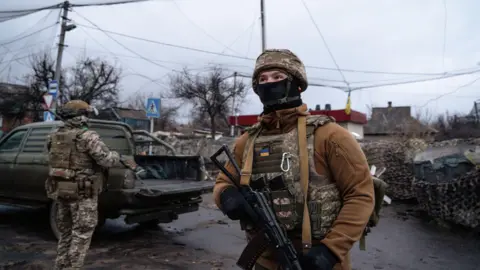
As Ukraine's soldiers fight, the government is trying to secure the country's economic future
For Ukraine the financial frontline is perhaps the unseen battlefield in the war with Russia.
Keeping the economy on a level footing isn't just about today, but central to the future that they've spent four years fighting for.
"We don't want to be just a poor neighbour [to the EU]," says Ukraine's Finance Minister Sergii Marchenko.
"We want to provide for Europe, something which they lack," he explains, in reference to the military expertise that the country has reluctantly gained since February 2022.
Marchenko adds that the "very painful" experience his country has gained could help the rest of the continent defend itself.
Membership of the EU is a top priority for Kyiv, so there is a lot of gratitude for the bloc's financial support, which is bringing the two closer together, and aiming to give Ukraine the advantage over Russia.
A new €90bn ($105bn; £79bn) loan from the EU will help cover the shortfall in Ukraine's budget over the next two years. It's been approved by the European Parliament, and the first payment could be made in April.
That loan is the biggest share of a $136.5bn (£101bn) international support package, without which Marchenko says his country cannot survive after everything it's been through.
"Our strong army depends on our strong economy, because all of our resources, which we mobilize internally, we channel... to defend our nation," he says.
"We are grateful for the support of other nations to help us, but definitely Ukraine's taxpayers are doing the best help for our army."
In December 2024, taxes in Ukraine were increased for the first time since the war began, including on personal incomes, small businesses and financial institutions.
That's part of the reason why domestic sources are expected to bring $67.5bn into government coffers this year, a 15% increase from a year earlier.
However, the government's budget for 2026 includes spending plans worth about $112bn, with about 60% of that going towards the army. That leaves a shortfall of around $45bn.
To bridge the gap the government is trying to get contentious new tax increases through parliament before the end of this month.
As part of the terms of a new $8.1bn loan that the International Monetary Fund (IMF) recently approved, digital platforms in Ukraine will have to pay more tax, and exemptions to value added tax will be reduced.
Kyiv received the first $1.5bn from the IMF at the start of this month. Ahead of that the IMF's mission chief for Ukraine, Gavin Grey, said that with its spending needs "expected to remain very high" the country needed to live within its means.
In addition to outside help, "Ukraine will also need to do more to tackle tax evasion and avoidance, and mobilizing domestic revenue in the near-term", he said.
The IMF support is crucial to unlocking the EU money, which has become even more significant since US financial support dried up.
Ukraine could run out of funds by the end of April so is also rushing to meet other EU conditions. A government source said that social and humanitarian expenditures remain its "key priorities".
Kyiv says slow repairs to the pipeline delivering Russian oil to Hungary are because its repair crews have been injured by further Russian attacks.
Some though, think the reforms Ukraine is implementing are the wrong path to ensure the war-torn country's economic survival.
"We believe that Ukraine, by continuing the war and increasing taxes, is moving toward default and economic collapse", says the think tank the Ukrainian Institute of the Future in a recent assessment of the economy.
The war is also straining Russia's much larger economy, however its military effort is worth 5.1% of GDP. That compares to 27% of Ukraine's GDP going on its military.
 Reuters
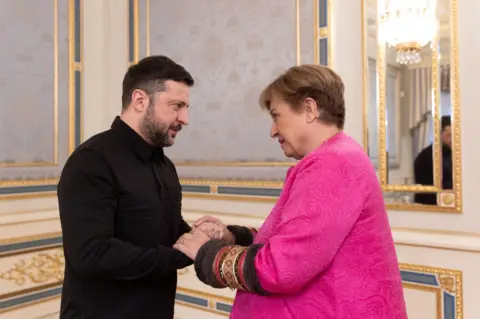
IMF Managing Director Kristalina Georgieva had encouraging words for Ukraine when she visited in January
It means that after four years of war with Russia, Ukraine's government is dependent on foreign aid to pay for spending ranging from pensions to healthcare and education.
That includes a plan to expand a programme for free school meals to cover the whole country from September, and this year's 30% pay rise for teachers, who the government says are playing a crucial role in supporting children through the war.
Yet inflation remains a problem despite falling from a wartime peak of 26.6% to the current 7.4%. It means that many businesses and consumers across the country are also feeling the financial strain of the war.
On the snow-covered streets of Kyiv, 65-year-old Tetiana explained the challenges. "I'm a pensioner and I have to work because the pension is small and not enough. Prices for food and utilities have increased."
Mykyta, 19, works in the kitchen of a restaurant. It's one of many companies that are struggling to get by.
"Salaries are not very high and there are problems with people. The team is small, because it's hard to find people to fill the staff."
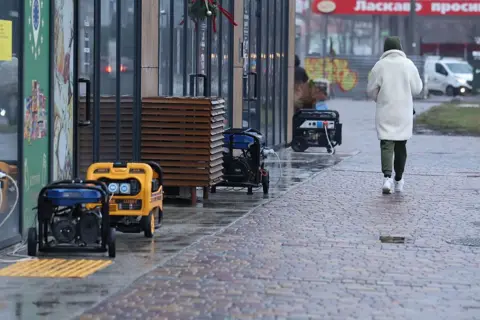
He adds that "During power outages, the kitchen doesn't work, we have to struggle with the generator".
That's a struggle many businesses share, with Ukraine's central bank saying recently that "The difficult situation in the energy sector will continue to restrain business activity for a long time".
It's why it cut the forecast for economic growth this year from 2% to 1.8%, although the latest IMF forecast is for growth of 1.8 to 2.5%.
 Global Images Ukraine via Getty Images
Rows of generators outside stores are now a common sight across Ukraine
For the economy as a whole, "The biggest challenge is that we haven't sufficient electricity", says Marchenko
He explains it means that companies can't be as productive as they want to be, and are having to increase the price of their products to cover the use of generators.
That's why he says "All of our governmental programs now channel our resources to partly restore capacity to generate electricity".
The importance of doing that and boosting economy growth was underlined by last month's estimate of the reconstruction and recovery bill for Ukraine put together by its own government alongside the EU, World Bank and UN.
The price tag of $588bn is almost two and a half times the size of the entire economy, and includes putting right damage to housing, transport and other infrastructure, as well as removing mines from areas around the frontline.
The challenges haven't stopped the president of the Ukrainian Chamber of Commerce and Industry, which represents more than 8,000 companies across the country, from being optimistic about the future.
"Despite the war we see how [foreign] business are interested in, and starting to invest in, Ukraine," says Gennadiy Chyzhykov.
"The new trend, we see a lot of delegations who visit Ukraine asking what we need, and how to start to prepare for after the war, reconstruction, the rebuilding.
"They believe in the victory, and they believe in the good business in Ukraine."
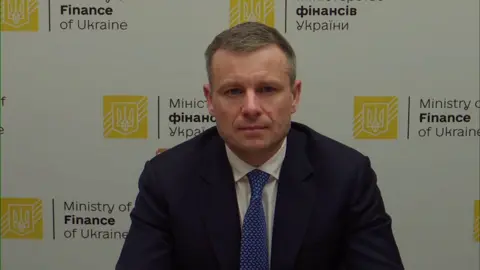
Ukraine's finance minister Sergii Marchenko says that during wartime a strong army depends on a strong economy
However, a shortage of workers with the right skills is an ongoing challenge that shows no signs of abating given that millions of people have either joined the army or left the country.
The UN's International Labour Organisation has suggested there will be a shortage of 8.7 million workers when it comes to reconstruction, and some business leaders have suggested the answer is to import workers from abroad.
A lot of support is coming from the European Bank for Reconstruction and Development (EBRD), which has spent more than $10bn in Ukraine since the war began.
"I think the challenge will be immense but it can be managed," says its president Odile Renaud-Basso.
She says many foreign companies are willing to invest but "having a real just peace, credible peace settlement, will be key, for investors to be sure that there is not a risk of the war will start again".
Yet with little sign of any end to the war she adds that the EBRD has the resources "to continue to support Ukraine in the war for how long it takes".
The ongoing struggle both on the battlefield and balancing the government's books means Ukraine's finance minister admits: "We need support, military support, and budgetary support."
However, Marchenko says the challenges of a wartime economy are driving changes that could lead to a "better economy for the future".
"The Ukrainian people and our government and economy are resilient and determined to fight this war, because we defend ourselves and we will."
Read more global business stories